The Earnest Mask: Xi Jinping Without the Parables

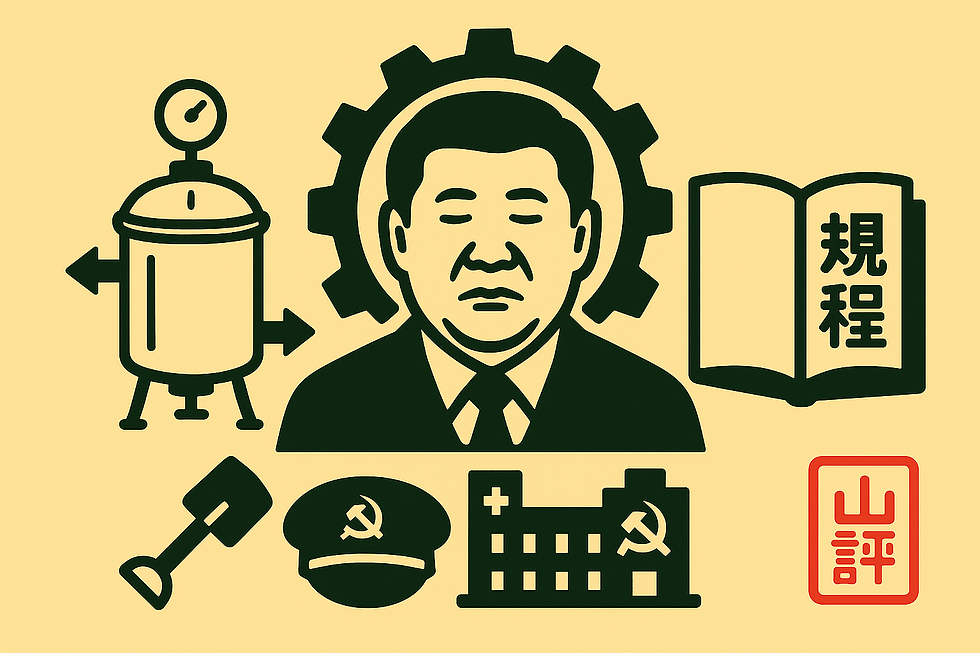
Xi’s story involves less belief than procedure: a youth shaped by hardship into a method that would one day govern a state. Chinese writing enjoys turning biography into parable: endurance becomes virtue; frugality, wisdom; obedience, destiny. Western analysis prefers another set of images: the technocrat, the autocrat, the apparatchik. In short, each system shapes lives into forms that flatter its own convictions. The Party requires sainthood; the West, pathology; both convert contingency into moral sequence. This attempts a third reading—not necessarily truer but ultimately more attentive to the record as it stands, keeping speculation to a minimum. The Xi Jinping that emerges appears less as a man than as a system learning to renew itself. Whether anything endures beneath that surface—private doubt, unscripted affection, the faint residue of a self shaped to fit the machine—cannot be known. The archive, like its subject, is mapped in utilitarian terms. The Cave Years Xi’s father, Zhongxun, a senior revolutionary, was imprisoned. His half-sister, Heping, killed herself after persecution by Red Guards. In 1969, the family's surviving son was sent to the loess plateau with a trunk of books and a name that still opened hearts but no doors. Educated in the capital, he stood taller than the villagers and spoke a clear Mandarin, not the Yan'an dialect—Jin-Chinese, nasal and clipped—that once carried the revolution's anthems. Liangjiahe was poor even by Yan'an standards. Its hundred households were mostly cave dwellings cut into yellow clay and connected by roads that turned to glue in the rain. Temperatures were moderated by a brick kāng (炕)—small comfort to a fifteen-year-old who had lived in Zhongnanhai—and fleas came out at feeding time. He would later write that he was “lonely at the beginning,” but that “after losing myself among the people, I felt happiness.”* In textbooks the sentence is treated as revelation, a formative moment, yet at the time it could just as easily have been rehearsal—either a boy finding comfort in anonymity or a future leader drafting the origin myth he would return to for decades. Half a century of repetition has blurred the difference beyond recovery. After a few months he ran. He reached Beijing by bus and train before being arrested in a crackdown on deserters, spending six months digging ditches in a labour camp. When he returned to Liangjiahe, he did not run again. He learned what the system rewards: endurance. In 1972, when his father was briefly released under Zhou Enlai's orders, Xi Zhongxun allegedly failed to recognise his sons. Whether this happened matters less than the son's choice to preserve it. By repeating the story, Xi turned private wounds into collective catechism: proof that loyalty costs even memory. The gesture has its own genealogy. In the Zuo Zhuan for example, Zeng Shen refuses to recognise his father during war; in Ming loyalist tales, a scholar who cannot name his child after the fallen dynasty is praised for sanctified restraint. Xi places himself in this moral grammar: performance becomes proof. Back in Liangjiahe the food was worse than the fleas. Wheat flour gave way to coarse cornmeal, ten kilos a month. Meat appeared rarely, sometimes not for months. "Months without meat" appears so often in testimony that it may as well be a unit of time.** Hunger was not metaphor but pedagogy. When he stopped petitioning to return and began repairing dikes and building biogas pits, the villagers stopped tittering. The "biogas experiment"—a sealed pit where pig manure fermented into methane—was modest but effective. A tank boiled millet and, on one occasion, when the first rush of gas met the open air it sent a spray of slurry across Xi's face. He told this story often, associating humiliation with authenticity, the coin of revolutionary virtue. Importantly, the process was more than a parable: contain waste in an airtight chamber, apply pressure. Wait. Harvest the flame. It was not a metaphor for his governance; it was its prototype—patience, containment and extraction. He applied to join the Party seven, eight, perhaps ten times, the numbers are fluid. The door that stayed shut taught him how to build others that would not open. In 1974 he was finally accepted and made village Party secretary. His first pledge was simple: "Let every household eat meat, and eat it often"—a vow as practical as it was redemptive.*** Forty years later, in Seattle, he repeated it almost verbatim. A statement of both sincerity and design, balanced with near-perfect symmetry. In the Party's arithmetic, consistency is the substitute for personality—the proof that a man will never improvise—it’s determinism all the way down. Villagers remember Xi as a laconic man. In nearby Zhaojiahe he led "socialist education" sessions and told tales from Journey to the West and Romance of the Three Kingdoms. Silence in one village, storytelling in another—each committing to a form of commanding presence. When he left for Tsinghua in 1975, they pushed him to the county seat in a wheelbarrow. He cried, according to the record. Decades later he returned with gifts: a few wristwatches, a red flashlight. Gesture for gesture, the moral ledger balanced. The University and the Army Tsinghua between 1975 and 1979 offers little to a biographer beyond a degree and a personnel file. No leisure, few friendships. This is not an omission but evidence of the Party's quiet efficiency in converting life into a moral record.
He studied engineering but lived by protocol. As class branch secretary he vetted peers, organised study sessions, and filed reports. He married Ke Lingling, a diplomat's daughter. The marriage ended within a few years, reportedly over her wish to move abroad. It remains the only personal relationship preserved from that era, and probably only because divorce leaves a paper trail. Even here the narrative corrects itself into a morality play: she sought comfort, he stayed to build a country. Here, the books from Liangjiahe—Tolstoy, Marx, Machiavelli—return like props restored to stage. A teacher remembered him as "studious," "elaborately polite," and fond of Du Fu—the Tang poet who turned exile into moral vision. It is possible, of course, to feign affection for any poet in the canon; many cadres prefer the grandeur of Li Bai or the stoicism of Tao Qian. To choose the Wild Old Man of Shaoling is to nudge closer to the bureaucrat's lament, evoking a displacement endured rather than overcome. Whether that fondness was genuine or merely strategic is impossible to know. It reveals something rare in the record: an identification not with power but its loss. Yet even his sentimentality is disciplined, it brims with regulated melancholy, loyal sorrow. We are far from cutting a Cao Cao figure. After graduation he entered the Central Military Commission as secretary to Defence Minister Geng Biao. From 1979 to 1982 he absorbed the army's ethos: punctuality, hierarchy, deference measured in micromovements. Geng's daughter recalled her father's verdict—"reliable." Not brilliant but reliable. In the PLA of that decade, still nursing humiliation from Vietnam, that was the high praise. Occasionally that reliability shaded into stuffiness. One recollection from Geng’s staff has the general teasing him as Lǎo Xí (老习) — Old Xi — an inversion of rank. Half rebuke and half indulgence, it pointed fun at a youth practising the posture of authority. In 1980 he followed Geng to the United States, ticking off the Pentagon, Pearl Harbor, Fort Bragg, and a carrier deck. He witnessed American power at his superior's shoulder and studied it as one examines a circuit board: more audit than awe. Under Geng he learned the Party's governing theorem: the Party commands the gun. To love the army too much is to risk its ambition; to neglect it is to risk its appetite. His later solution was liturgical: parades, purges, loyalty tests—rituals through which obedience renewed itself. The Climb: Guanxi as Infrastructure The 1980s and 1990s moved him through Hebei, Fujian, Zhejiang and Shanghai—appointments that looked procedural but were thick with calculation. His father's rehabilitation reopened doors but guaranteed little. The Party was an aristocracy of survivors, every founder’s son clutched an unspent inheritance. Xi's gift was to turn patience into strategy, to make invisibility read as loyalty. Hebei (1982–85) taught him that competence sans patronage was its own form of power. He performed reliably for the right witnesses, collecting small but durable allegiances. He was not a schemer so much as a believer in systems that rewarded the competent. In a Party built to distrust charisma, reliability was the highest form of cunning. Then came Fujian (1985–2002)—seventeen years on one frontier, long enough to master the dialect of discretion. It was Jia Qinglin's province and, by extension, Jiang Zemin's. Xi delivered growth and they delivered protection, a transaction disguised as tutelage. The Yuanhua smuggling scandal of 1999 nearly detonated the province with billions in contraband and officials everywhere implicated—all except Xi. He had managed to be adjacent to the problem and central to its solution. In a system that prizes containment over confession, his silence was heroic, and he showed he could save the Party from itself. By 2002, in Zhejiang, he spoke the dialect of modernisation fluently: GDP, pollution metrics, infrastructure timelines. He folded private entrepreneurs into Party committees, making capital legible and taxable. He was factionally bilingual, acceptable to Jiang's old guard and to Hu Jintao's populists, and his neutrality naturally clouded into an aura. Shanghai (2007) was the final test as Jiang's city, his fortress. Xi was sent to steady it after a corruption purge. He did so by doing almost nothing. No crusades, no slogans, no visible errors. When he rose to the Standing Committee that autumn, his blankness gleamed like qualification. The Procedural Turn By the turn of the century his manner had calcified. To foreigners he appeared austere; to colleagues, incorruptible. He cultivated an image of virtue unencumbered by personality: rolled sleeves, factory visits, classical quotations as milestones. He exuded the composure of a man who would never surprise his superiors. "Officials," he instructed, "should speak so people understand you at once and remember you later."**** In brief, trim away everything ornamental, leave only what performs as small deliverables outlast big ideals. His charisma lay in the refusal of charisma. He became indispensable by being ungraspable. The ideal cadre must be transparent upward, opaque downward; Xi made this equilibrium seem like temperament. His marriage to Peng Liyuan in 1987 completed the portrait. She was already a national voice, her anthems stitched into the Party's sentimental fabric. Xi, as an obscure county official, gained both glamour and moral varnish. Not that the sheen was false. On the contrary, much of it goes down to the soul. Xi belongs to the last generation raised before consumption became civic virtue. For him, virtue meant production. His Marxism is moral before it is material: decadence decays, labour redeems. He trusts what can be built and mistrusts what merely circulates—finance, faith, unanchored thought. Modernity, to be safe, must wear a uniform; it must be accountable. By the 2000s procedure had become metaphysics. Reform did not open the system; it pressurized it. Every problem was a vessel to be sealed, every deviation a leak to be contained. The Party was an assembly line of valves. You understand such a machine not by asking what it believes but watching what it forbids. And this was the grammar that would later govern the state: order as containment, discipline as design, history as maintenance schedule. The cave's lesson—contain, pressurise, extract—scaled to empire. What His Opacity Does The caves of yore became allegory only later, when the state required proof that virtue could be manufactured. The West, mistaking blankness for banality, offered its own caricature. Both make a consolation of history. The truth lies in the machinery itself—where procedure replaces personhood. Opacity is not concealment but signal. It announces that nothing remains to be discovered. The Party distrusts interiority, preferring what can be audited. Repetition becomes verification. Each slogan, each anecdote, each Du Fu quotation functions as a maintenance log of belief: predictability as the last form of sincerity left standing. This is what his opacity does politically. In a structure that demands ideological certainty, a leader without visible conviction is the perfect instrument. Allies see agreement, while rivals see mist. He enforces orthodoxy without appearing doctrinaire because he embodies not the doctrine but the machinery that manufactures it. Once enthroned, he governed as an engineer under pressure. The anti-corruption drive sealed leaks. Technology firms were reabsorbed. Hong Kong was reclaimed by paperwork, not troops. Even Zero-COVID, maintained beyond reason, obeyed the same thermodynamics: the faith that control itself could disinfect. The pattern never varies—identify leakage, apply pressure and wait for compliance. The biogas pit still burns, its chamber vast, its waste refined. Containment is policy; endurance, its creed. Whether this is conviction or conditioning no longer matters. The record shows only functions, stories polished for reuse, gestures indexed to authority. What remains is a human instrument honed to the purity of purpose. The mask was never meant to hide. It was meant to prove there was nothing left to hide—that the man had become transparent to the system that made him. Earnestness, in this dialect, means obedience rendered visible. He governs as he once laboured: through methodical containment. The earnest mask is not a disguise but a device—the final form of visibility in a politics that has replaced character with procedure. The caveman became the chairman but the older architecture endures: pressure, containment, flame. If a soul survives behind the apparatus, it has learned to operate indistinguishably from the machinery itself. Postscript: On Sources
This essay draws on the scattered record left by official biographies, memoirs of contemporaries, provincial gazetteers, and interviews conducted by foreign correspondents over five decades. Where Chinese and English-language accounts diverge, preference has been given not to the more dramatic but to the more repeatable. In Party historiography, repetition is a higher form of truth than verification. Certain details—his sister's suicide, the manure-splashed biogas pit, the six months of digging ditches—appear in too many incompatible versions to be entirely false. Others, like his father's failure to recognise him, survive only because they were retold. As with all official lives, what endures has been curated by the subject or his chroniclers for instructional value. Quotations from Xi's own speeches and essays derive from The Governance of China and from provincial reports reprinted in the People's Daily. Their diction, disciplined to the point of transparency, performs the same reliability it describes. Villager testimonies come mainly from collections published after 2012, where nostalgia and pedagogy merge without visible seam.For events in Fujian and Zhejiang, the chronology follows contemporary provincial bulletins and the work of journalists who, briefly and bravely, were allowed to write them. The precise mechanics of factional alliance—Jia Qinglin's sponsorship, Jiang Zemin's approval—belong to the shadow archive of Chinese politics, legible only through inference: who rose, who fell, who wrote the preface to whose collected speeches. The purpose here has been to describe what remains when the self is institutionalised into method. Where the record ends, the analysis stays with the documented pattern: the biogas pit, the pressure chamber, the controlled flame. In this sense, the essay does not break the Party's spell of legibility but inhabits it—to see what kind of truth the system allows to survive. ________________ * 开始的时候很孤独,后来慢慢地就习惯了,融入到群众之中,就觉得很快乐. ** 有好几个月没吃到肉. *** 让每家每户都能吃上肉,而且经常能吃上肉. **** 说话让人一听就懂,一记就住.


