Recomposition After Adrienne Rich
- Qu Yuan

- Feb 9
- 3 min read
Updated: Feb 19
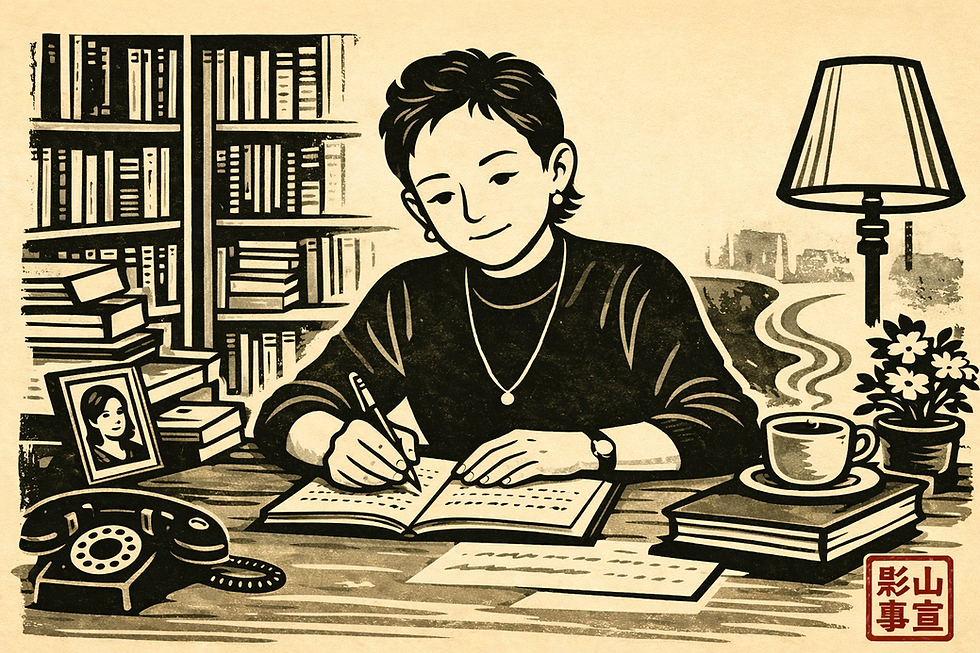
Adrienne Rich's "From a Survivor," from Twenty-One Love Poems (1973), works with statements that sit beside each other rather than building upward, clauses that lean into adjacency instead of nesting through subordination. Her thinking proceeds in discrete units. One image, then another. Meaning accrues not through syntactic hierarchy but through what stands next to what.
English has trouble with this. It wants to explain, to connect, to make the relationship between ideas explicit. The result in Rich's work is a persistent sense of gesture—clauses reaching toward one another across white space, implication doing the work that grammar refuses to formalize.
The premise of what follows below is slightly mischievous but also terribly serious. Rich is, in a technical sense, trapped by her own language. She wrote poetry that English sustains only with effort and apology. Modern Mandarin, by contrast, is built for exactly this mode: it shimmers brilliantly when indulging declarative sequencing, parataxis, and meaning carried by placement rather than explanation. It tolerates statements without rhetorical inflation and motion without transcendence. What feels strained in English clarifies when the language itself stops demanding justification for every turn.
This experiment, then, is not to "render Rich in Chinese" but to supply the poet with a linguistic toolkit better suited to what she tried to do. There is, admittedly, a key change: emotional interiority is dialled back a bit in favor of cognitive accounting. Metaphor becomes a change in status rather than a moment of revelation.
The closeness to the original is deliberate and visible. This is neither naked translation nor homage. The point is to show that what feels gestural, even strained, in English can operate with clarity in a language that does not demand quite so much psychological justification or lyrical payoff. That this language lies on the other side of the world is incidental. What matters is that it is there, ready to give voice to a poem that English could only express partially, even at its most eloquent.
The poem below is a recomposition after Adrienne Rich (1929–2012).
还活着
我们当年立下的, Wǒmen dāngnián lì xià de,
不过是那个时代 Búguò shì nàgè shídài
男人和女人都会立下的约定。 Nánrén hé nǚrén dōu huì lì xià de yuēdìng.
我们并不知道自己是谁, Wǒmen bìng bù zhīdào zìjǐ shì shéi,
却以为自己的性格 Què yǐwéi zìjǐ de xìnggé
足以抵抗整个人类的失败。 Zúyǐ dǐkàng zhěnggè rénlèi de shībài.
幸与不幸,当时都不明白。 Xìng yǔ bùxìng, dāngshí dōu bù míngbái.
我们不知道失败 Wǒmen bù zhīdào shībài
可以大到那种程度, Kěyǐ dà dào nà zhǒng chéngdù,
也不知道我们终究会分得一份。 Yě bù zhīdào wǒmen zhōngjiū huì fēn dé yí fèn.
和所有人一样, Hé suǒyǒu rén yíyàng,
我们以为自己是例外。 Wǒmen yǐwéi zìjǐ shì lìwài.
你的身体 Nǐ de shēntǐ
对我依然清晰, Duì wǒ yīrán qīngxī,
甚至比从前更清晰。 Shènzhì bǐ cóngqián gèng qīngxī.
因为现在我终于知道 Yīnwèi xiànzài wǒ zhōngyú zhīdào
它能做什么, Tā néng zuò shénme,
不能做什么。 Bù néng zuò shénme.
它不再是神的身体, Tā bù zài shì shén de shēntǐ,
也不再对我的生活 Yě bù zài duì wǒ de shēnghuó
拥有任何权力。 Yǒngyǒu rènhé quánlì.
如果到了明年, Rúguǒ dào le míngnián,
本该是二十年。 Běn gāi shì èrshí nián.
而你却过早地死去... Ér nǐ què guòzǎo de sǐqù...
一种浪费。 Yì zhǒng làngfèi.
你本可以跨过去, Nǐ běn kěyǐ kuà guòqù,
那一步, Nà yí bù,
我们谈论过, Wǒmen tánlùn guò,
却谈得太晚。 Què tán dé tài wǎn.
而我现在活着, Ér wǒ xiànzài huózhe,
不是跨越, Bú shì kuàyuè,
而是一连串 Ér shì yì liánchuàn
短暂、惊人的动作。 Duǎnzàn, jīngrén de dòngzuò.
每一个, Měi yí gè,
都让下一个 Dōu ràng xià yí gè
成为可能。 Chéngwéi kěnéng.